I live without cash – and I manage just fine
Armed with a caravan, solar laptop and toothpaste made from washed-up cuttlefish bones, Mark Boyle gave up using cash (ref Guardian Blog article)
A Notice from the Blogger.
There are a number of other people who claim to live without money. It shows that cash is not absolutely "necessary" within an economy. RS
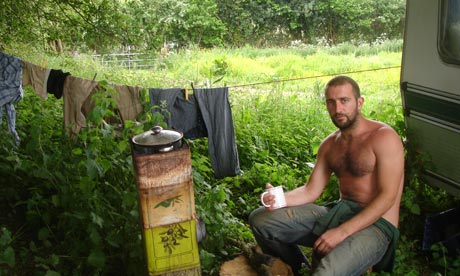
Mark Boyle outside his off-grid caravan. Photograph: Mark Boyle
In six years of studying economics, not once did I hear the word "ecology". So if it hadn't have been for the chance purchase of a video called Gandhi in the final term of my degree, I'd probably have ended up earning a fine living in a very respectable job persuading Indian farmers to go GM, or something useful like that. The little chap in the loincloth taught me one huge lesson – to be the change I wanted to see in the world. Trouble was, I had no idea back then what that change was.
After managing a couple of organic food companies made me realise that even "ethical business" would never be quite enough, an afternoon's philosophising with a mate changed everything. We were looking at the world's issues – environmental destruction, sweatshops, factory farms, wars over resources – and wondering which of them we should dedicate our lives to. But I realised that I was looking at the world in the same way a western medical practitioner looks at a patient, seeing symptoms and wondering how to firefight them, without any thought for their root cause. So I decided instead to become a social homeopath, a pro-activist, and to investigate the root cause of these symptoms.
One of the critical causes of those symptoms is the fact we no longer have to see the direct repercussions our purchases have on the people, environment and animals they affect. The degrees of separation between the consumer and the consumed have increased so much that we're completely unaware of the levels of destruction and suffering embodied in the stuff we buy. The tool that has enabled this separation is money.
If we grew our own food, we wouldn't waste a third of it as we do today. If we made our own tables and chairs, we wouldn't throw them out the moment we changed the interior decor. If we had to clean our own drinking water, we probably wouldn't contaminate it.
So to be the change I wanted to see in the world, it unfortunately meant I was going to have to give up cash, which I initially decided to do for a year. I got myself a caravan, parked it up on an organic farm where I was volunteering and kitted it out to be off-grid. Cooking would now be outside – rain or shine – on a rocket stove; mobile and laptop would be run off solar; I'd use wood I either coppiced or scavenged to heat my humble abode, and a compost loo for humanure.
Food was the next essential. There are four legs to the food-for-free table: foraging wild food, growing your own, bartering, and using waste grub, of which there is loads. On my first day, I fed 150 people a three-course meal with waste and foraged food. Most of the year, though, I ate my own crops.
To get around, I had a bike and trailer, and the 34-mile commute to the city doubled up as my gym subscription. For loo roll I'd relieve the local newsagents of its papers (I once wiped my arse with a story about myself); it's not double-quilted, but I quickly got used to it. For toothpaste I used washed-up cuttlefish bone with wild fennel seeds, an oddity for a vegan.
What have I learned? That friendship, not money, is real security. That most western poverty is of the spiritual kind. That independence is really interdependence. And that if you don't own a plasma screen TV, people think you're an extremist.
People often ask me what I miss about my old world of lucre and business. Stress. Traffic jams. Bank statements. Utility bills.
Well, there was the odd pint of organic ale with my mates down the local.
• Mark Boyle is the founder of The Freeconomy Community. In a subsequent blog he responds to the comments below.


