Showing posts with label future. Show all posts

Tuesday, 11 October 2016

Stephen Hawking on the Future of Capitalism and Inequality

Black & White photo of Hawking at NASA.


/Counterpunch   

Pic Wikipedia


Last Thursday, the acclaimed physicist and cosmologist, Stephen Hawking, dropped a truth-bomb about capitalism and the future of inequality. With the rapid technological advancements of the past few decades (e.g. computer technology, robotics), we have seen economic inequalities grow at alarming rates, and a kind of plutocratic class of owners — that is, capitalists — become immensely wealthy. Hawking believes that, if machines do end up replacing human labor and producing all of our commodities, and we continue on the current neoliberal route, we are on our way to becoming a sort of dystopia of a top ownership class, with immeasurable wealth, and a bottom ownerless class — that is, the masses — living in abject poverty. In a Reddit Ask Me Anything session, Hawkins wrote:
“If machines produce everything we need, the outcome will depend on how things are distributed. Everyone can enjoy a life of luxurious leisure if the machine-produced wealth is shared, or most people can end up miserably poor if the machine-owners successfully lobby against wealth redistribution. So far, the trend seems to be toward the second option, with technology driving ever-increasing inequality.”
The replacement of human labor by machines has always been a fear for working class people. Back in the midst of the industrial revolution, it resulted in a worker backlash known as the luddite movement, where in England, textile workers protested layoffs and economic difficulties by destroying industrial equipment and factories. Today, we see this with the elimination of many previously stable manufacturing jobs in cities like Baltimore and Detroit, replaced largely by automation. This kind of technological innovation that we see throughout the history of capitalism is what Joseph Schumpeter called “creative destruction,” which he describes as a “process of industrial mutation that incessantly revolutionizes the economic structure from within, incessantly destroying the old one, incessantly creating a new one.” Schumpeter called this process “the essential fact about capitalism.”
Creative destruction has always garnered a net positive for society. While innovations eliminate jobs for many, new technologies historically create new industries and new jobs that come with them. This inherent process of capitalism rapidly increases worker productivity and therefore makes once luxurious goods available to a wider spectrum of the population. New technologies help produce significantly more products, which then flushes the supply, and pushes down the price to meet demand.
As I said above, historically, creative destruction ends up producing new jobs after eliminating old ones. But today, it seems we may finally be heading in another direction, and technology has already begun to eliminate more jobs than it creates. Nothing exemplifies this more than the “big three” automakers back in 1990 (GM, Ford, Chrysler) compared to the big three tech companies of today. In 1990, the American automakers brought in $36 billion in revenue altogether, and employed over one million workers, compared to Apple, Facebook, and Google today, which together bring in more than one trillion dollars in revenue, yet employee only 137,000 workers.
And how about American manufacturing compared to the financial industry? Since the 1950’s, the financial industry has gone from enjoying around 10 percent of domestic corporate profits to around 30 percent today(with a high of 40 percent at the start of the century), while manufacturing has dropped from close to 60 percent of corporate profits to around 20 percent. But what is really telling is each industries domestic employment. The financial industry’s employment has remained quite steady over the past sixty years, at under 5 percent, while manufacturing has dropped from 30 percent to under 10 percent. This has a lot to do with the financialization of the American economy, but also the rise of automation. And it’s not about to get any better. According to an Oxford University study from 2013, up to 47% of jobs may be computerized in the next 10 to 20 years.
The middle class has been hit the hardest over the past few decades, and it will continue to be hit hard in the coming decades at this rate. From 1973 to 2013, for example, a typical workers compensation only increased by 9.2 percent, while their productivity increased by about 74.4 percent. Compare this to the post-war period (1948-1973), where productivity rose by 96.7 percent and worker compensation by 91.3 percent. At the same time, the top one percent wage has grown by 138 percent since 1979, while the ownership class has seen their wealth accelerate at a rapid clip. During the late ‘70s, the top 0.1 percent owned just 7.1 percent of household wealth in America, while in 2012 that number had more than tripled to 22 percent, which is about equal to the bottom 90 percents household wealth. Think about that. Just 0.1 percent of a population owns as much wealth as 90 percent.
Now, as Hawking’s said, there seem to be two possibilities. The future may become even more unequal as technology continues to replace labor and leave the masses unemployed and ownerless (currently, this seems more probable), or, if wealth is more evenly distributed, everyone could enjoy “luxurious leisure,” or as Karl Marx famously put it:
“In communist society, where nobody has one exclusive sphere of activity but each can become accomplished in any branch he wishes, society regulates the general production and thus makes it possible for me to do one thing today and another tomorrow, to hunt in the morning, fish in the afternoon, rear cattle in the evening, criticise after dinner, just as I have a mind, without ever becoming hunter, fisherman, herdsman or critic.”
The influential economist, John Maynard Keynes, believed that the future of capitalism (as oppose to socialism or communism, as Marx believed) would bring this leisurely existence to human beings. In his 1930 essay, “Economic Possibilities for our Grandchildren,” he predicted that the growth and technological advancements that capitalism provided would lower the average working week to fifteen hours within a century, making what to do with one’s free time our biggest concern. On money, Keynes provided a hopeful prediction with the singing prose he became known for (barring his exceptionally dry General Theory).
“The love of money as a possession -as distinguished from the love of money as a means to the enjoyments and realities of life -will be recognised for what it is, a somewhat disgusting morbidity, one of those semi-criminal, semi-pathological propensities which one hands over with a shudder to the specialists in mental disease.”
Keynes made some prophetic predictions in his day, but this was not one of them. Today, it seems Marx’s analysis of capitalism better fits the great economic inequalities and the global mobility of capital.
Still, nothing is set in stone. The rise of Bernie Sanders, for example, reveals a growing movement ready to combat the neoliberal status quo that has come to dominate American (and global) politics. If the economy continues on the road it is on, the question of wealth distribution will no longer be just a moral question of how great a level of inequality we as a society are willing to accept, but a question of political and economic stability. The ownership of capital will ultimately determine this future, but there are other movements and policy ideas with this future in mind, such as a guaranteed basic income, where all citizens, once they reach a certain age, are provided a stipend, which would likely replace traditional safety nets. Switzerland may be the first country to enact this policy, and a vote will likely come in 2016. The proposed plan would provide a guaranteed monthly income of $2,600, or $31,200 annually; in other words, enough for everyone to survive and pursue work that they actually enjoy. For those on the right getting ready to scream the S-word, it should be noted that many conservatives and even libertarians, such as F.A. Hayek, have endorsed this idea. It has a surprising history of bi-partisan support, and would, at the very least, prevent extreme poverty in the future, as robots and computer technology continue to take human jobs.
The growing inequality around the world can no longer be ignored, and addressing this and the other problems of capitalism, such as environmental degradation, is not only the morally right thing to do, but the pragmatic thing to do.


BLOGGER REF  http://www.p2pfoundation.net/Transfinancial_Economics

Conor Lynch is a writer and journalist living in New York City. His work has appeared on Salon, Alternet, The Hill, and CounterPunch. 


Friday, 17 October 2014

To Save Everything, Click Here by Evgeny Morozov – review

Morozov takes a hard look at the claims of cybertheorists and concludes that our techno future might be dark and danger

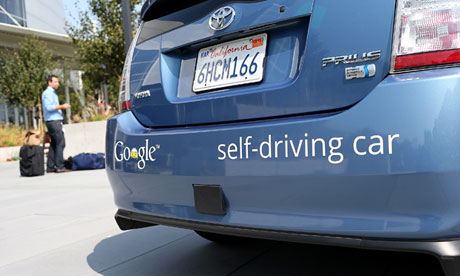
Google self-driving car
Utopia postponed … Google's self-driving car might have unintended consequences. Photograph: Justin Sullivan/Getty Images
Newsflash: the internet doesn't exist. If you think there is just one thing called "the Internet" with a single logic and set of values – rather than a variety of different networked technologies, each with its own character and challenges – and that the rest of the world must be reshaped around it, then you are an "Internet-centrist". If you think the messiness and inefficiency of political and cultural life are problems that should be fixed using technology, then you are a "solutionist". And if you think that the age of Twitter and online videos of sneezing cats is so unlike anything that has gone before that we must tear up the rule-book of civilisation, then you are an "epochalist". Such coinages are one of the drive-by amusements of reading Evgeny Morozov, who, since his first book, The Net Delusion, has become one of our most penetrating and brilliantly sardonic critics of techno-utopianism.
  1. To Save Everything, Click Here: Technology, Solutionism, and the Urge to Fix Problems that Don’t Exist
  2. by Evgeny Morozov
  1. Tell us what you think: Star-rate and review this book
He certainly has some colourful adversaries. One is Jeff Jarvis, a new-media cyberhustler and consultant who is serially wrong about the near future, and seemingly cannot bear to hear any criticism of his adored Silicon Valley corporations. Appearing on the BBC earlier this year after Facebook had been hacked, he accused his interviewer of spreading "technopanic", insisted the whole story was "crap", and said: "This interview shouldn't exist." Afterwards, he tweeted: "The BBC can kiss my ass," and "Fuck you, BBC."
Among Morozov's other targets are Amazon chief Jeff Bezos, with his "populist rage against institutions" (except his own); LinkedIn supremo Reid Hoffman, who has perpetrated a book-shaped product entitled The Start-Up of You; Google's Eric Schmidt, who believes that an algorithm could one day tell you what is the "Best music from Lady Gaga"; Microsoft engineer Gordon Bell, lifelogger extraordinaire and exemplary lunatic of the mindset that holds that Truth, in the form of perfect data recall, is the absolute social value; and the games-will-save-the-world theorist Jane McGonigal, whose work Morozov likens to "a bad parody of Mitt Romney".
But Morozov's attacks go deeper than a righteous ridicule – he also interrogates the intellectual foundations of the cybertheorists, and finds that, often, they have cherry-picked ideas from the scholarly literature that are at best highly controversial in their own fields. His readings in this vein of Clay Shirky, Steven Johnson, David Weinberger and numerous other cyberintellectuals are suavely devastating.
We must, Morozov argues forcefully, place today's arguments in a broader context. "To talk about gamification" – the management-theory fad that seeks to apply videogame-style motivations and rewards to real-world practices – "without also discussing BF Skinner's behaviourism," he writes, is "misguided". Here the Belarus-born author also justifiably plays an autobiographical trump card: "As someone who grew up in the final years of the Soviet Union, even I remember the penchant that Soviet managers had for gamification: students were shipped to the fields to harvest wheat or potatoes, and since the motivation was lacking, they too were assigned points and badges."
The cyberhustlers are constantly declaring Year Zero and demanding that society be reformed according to the demands of "the Internet". But their understanding of the institutions they dream of seeing torn down – politics, the media, and now even university education – is superficial, as is their understanding of "the Internet" itself, whose secretive, privately-owned corporations are nothing like as "open" as their cheerleaders insist everything else must henceforth be. (Another of today's serious digital critics, Jaron Lanier, emphasises this point in his latest book, Who Owns the Future?) The important and admirably fufilled purpose of Morozov's book, then, is to argue, as he finally sums up: "that there are good reasons not to run our politics as a start-up … that there are good reasons to value subjective but high-quality criticism, even if it doesn't stem from the 'wisdom of crowds' [… and] that numbers often tell us less than we think and quantification as such might actually thwart reforms."
Quantification, in the form of "Big Data", is the subject of Viktor Mayer-Schönberger and Kenneth Cukier's initially more celebratory book, Big Data: A Revolution That Will Transform How We Live, Work and Think. Now that we can collect and analyse vast quantities of data – often, all or nearly all the relevant data rather than just statistical samples – wonderful things can happen. Google predicts the spread of flu in near-real-time by analysing searches; engineers foresee the failure of engine parts that wirelessly phone home; and Walmart notices that, just before a hurricane hits, sales of Pop-Tarts increase. That there is a certain bathos to the progression of these examples is to be expected in an era that does not differentiate too pedantically between what is good for business and what is good for people.
Mayer-Schönberger and Cukier laudably demolish some of the more ludicrous big-data fantasies – for example, the claim by former Wired editor Chris Anderson that big data in science means "the end of theory" – but they also choose not to draw some arguably important distinctions. Is there, perhaps, a difference between "data" and "information" and "knowledge"? Might it be useful to distinguish between which articles a computer program has determined are "popular" on the internet, and which are actually worth reading?
The dark side of big data, according to the authors, lies in surveillance – in communist East Germany, they point out, the Stasi were aspiring big-data fanatics – and in the alarming prospect of Minority Report-style pre-emptive policing. (According to a study too recent to make it into either book, Facebook "likes" can already be used to accurately predict "sexual orientation, ethnicity, religious and political views, personality traits, intelligence, happiness, use of addictive substances, parental separation, age, and gender".) We could sleepwalk into a "dictatorship of data", where the algorithms mining the data for actionable recommendations are inscrutable and unaccountable "black boxes". So, these authors conclude, we need a new cadre of "algorithmists", people who scrutinise code for its obscured political choices.
Morozov, too, calls for "algorithmic auditors". (Already, he points out, a single Californian company determines automatically what will count as hate speech and obscenity in the comment systems of thousands of websites.) More imaginatively, he also points out many possible consequences of the social engineers' techno-fixes. "Would self-driving cars," he wonders pointedly, "result in inferior public transportation as more people took up driving?" If you can measure and upload your health, diet and fitness data to be "shared" with insurance companies, then you'll get cheaper insurance, say Mayer-Schönberger and Cukier cheerfully. But wait, says Morozov, such individual decisions don't take place in a vacuum: "If I choose to track and publicise my health, and you choose not to, then sooner or later your decision to do nothing might be seen as tacit acknowledgment that you have something to hide." These are, then, social and political problems, and ones that the mantra of individual choice cyborgised through shiny new technologies will often answer in ways that harm the already vulnerable.
In one amazing possible future, this newspaper's website would know, thanks to your aggregated personal data, whether you are already a fan of Jeff Jarvis and Clay Shirky: if so, it would then serve to you an alternative version of this review that scolded Evgeny Morozov for his curmudgeonly hatred of inevitable progress. Happily, we are not there yet, and we can still argue along with him about what sort of future we want. Data-dissidents of the world, unite: you have nothing to lose but your targeted adverts.
• Steven Poole's You Aren't What You Eat is published by Union Books. To order To Save Everything, Click Here and Big Data with free UK p&p call Guardian book service on 0330 333 6846 or go to guardian.co.uk/bookshop

Tuesday, 3 June 2014

New TED Book envisions the ‘living’ cities of the future

Posted by: Jim Daly 
What will the urban areas of tomorrow look like? More like an ever-changing and vibrant garden than a static set of buildings and blocks. In our new ebook Living Architecture: How Synthetic Biology Can Remake Our Cities and Reshape Our Lives, British designer and architect Rachel Armstrong re-imagines the world’s cities and argues that in order to achieve sustainable development of the built environment — and help countries like Japan recover from natural disasters — we need to rethink how we approach architecture. By genetically modifying biological systems  and studying such things as protocells — nongenetic self-organizing molecules that exhibit movement and sensitivity to their surroundings — we could create more responsive and dynamic structures. The result is a new kind of architectural practice where cities behave more like an evolving ecosystem than a lifeless machine. We recently spoke with Armstrong.
What do you mean by ‘living architecture’?
It’s a way of using ecological solutions to urban problems. Living architecture works by applying new materials and engineered systems that harness some of the unique properties of ‘life.’ Living technology is more robust and environmentally responsive than traditional materials, and can deal with unpredictability in a way that current technologies cannot.
How?
Our future cities will be designed more like gardens than machines. Buildings will perform functions that we currently attribute to the plant world, such as carbon capture. They will also contribute to the health of residents by removing pollution or providing food and energy.Living architecture is not a panacea to urban problems, but propose an alternative approach to making buildings  that may help alleviate these problem. Our cities, as they currently exist, as seen as inert barriers to the natural world. But these barriers are inevitably breached in the event of a natural disaster. What might happen if everyday buildings were designed with the seeds of regeneration?
What developments in biotech will make a difference?
Protocells, for one thing. Protocells are a very interesting technology in this new portfolio as they are not strictly speaking ‘alive’ – since they do not possess a biological set of instructions, such as DNA – but they do behave in a life-like manner. They can sense and move around their environment through chemical means. They can function together in groups and can be chemically programmed to lay down solid materials. They are one kind of living technology that will be part of a whole new portfolio of materials that architects will have at their disposal as they develop of our cities. These materials will literally transform inert, non-living building surfaces into dynamic, life-like ones that carry out a set of functions normally associated with ‘life,’ such as, growth, self-repair or recycling resources, like oil and water.
How far out are these concepts? When will we start to see them in play?
These technologies already exist in the laboratory and in prototype model form, although they still need research and development to turn them into widely available products. The ideas may seem outlandish but they are based on real technology that exists today. All applications of scientific research in the laboratory remain speculative until they are transformed into products. But we are heading that way.
Living Architecture: How Synthetic Biology Can Remake Our Cities and Reshape Our Livesis part of the TED Books series, which is available for the Kindle and Nook as well as on Apple’s iBookstore.

Friday, 24 January 2014

Building life from the bottom: Are underground cities the future?

Are underground cities the future?
Is building underground the future? (Picture: Getty)

Blogger Ref Link http://www.p2pfoundation.net/Transfinancial_Economics
With space costing a premium in cities, building up has become the norm. There is another option, however – could swapping skyscrapers for subterranean living be a solution?
A new project by designer James Ramsey of Raad Studio is looking beneath the streets of New York for an answer to the city’s limited green public spaces.
Designed in collaboration with executive director Dan Barasch, Lowline hopes to turn the site of an abandoned trolley terminal into the world’s first underground park.
Like its elevated predecessor High Line – a public park built on a freight rail line above the streets on Manhattan’s West Side – the project is successfully encouraging New Yorkers to think more creatively about urban green spaces.
It has already created a record for the largest number of supporters for an urban design project on funding platform Kickstarter – through which it raised more than £100,000 from 3,300 worldwide supporters.
‘The response from the local community and the city as a whole has been overwhelmingly positive,’ said Ramsey.
‘The Lowline idea comes from the intersection of my work with sunlight and optics and my love of urban archeology. I’d love to see a space that is a union of the two; something that reveres the history of our city while embracing the future.
‘I hope we don’t end up living underground, but I think we can use design and technology to exploit some of the amazing spaces beneath us in the right circumstances.’
2301-underground
The project’s proposed location is the one-acre former Williamsburg Bridge Trolley Terminal, just below Delancey Street on the Lower East Side of Manhattan.
Despite sitting unused since 1948 when the trolley service was discontinued, the space still retains its original 20ft vaulted ceilings, criss-crossing rail tracks and remnant cobblestones. More importantly, it is also located in one of the least green areas of New York City. To encourage the growth of plants and trees below street level, as well as tackle the problem of lighting, Ramsey has developed ‘remote skylight’ technology, which would transmit the necessary wavelengths of light to support photosynthesis.
‘Underground infrastructure can help the pedestrian experience at the street level, and underground spaces have a controllable temperature and environment,’ said Ramsey.
Ramsey is not alone in seeing opportunity in digging deep, with underground structures deemed as both energy efficient and a great way to preserve the appearance of green field and historic sites.
Pop Down by Fletcher Priest Architects is another such idea. The winner of the High Line for London competition to find new ideas for green space in the capital, the project proposes the transformation of the disused ‘Mail Rail’ tunnel under Oxford Street into an urban mushroom garden.
In addition to enabling visitors to explore subterranean London, the tunnels would create the ideal environment for an urban mushroom farm with the introduction of daylight through a series of sculptural glass-fibre ‘mushrooms’. The produce could also be used in pop-up concept restaurants and cafés at street level entrances.
‘There is a lot of hype around Lowline, but as things stand it is little more than a small patch of indoor greenery and a tree, neither of which are hardly new,’ said Matthew Carmona, professor of planning and urban design at the Bartlett School of Planning, University College London.
‘Cities in countries such as Canada, Japan and China, with severe winters or hot and humid summers, have long had extensive networks of underground walkways, often lined with shops and other facilities, as an alternate way of moving around the city; and in these, it is not uncommon to see plants, and even trees.’
He added: ‘To my mind, the Pop Down project is a more interesting idea. Mushrooms underground seems more fitting somehow than trying to make greenery blossom beneath our streets.’
With high building costs, an absence of natural lighting and sunlight penetration and the need for artificial ventilation all potential problems for underground construction, Prof Carmona believes we should continue to build cities in the traditional way.
‘This has served us well for thousands of years and shows no prospect of not doing so equally well in the future. There is plenty of room and potential to meet our needs above ground,’ said Prof Carmona.
As land prices in London continue to rise however, Prof Carmona suggested that more residents might choose to excavate under their homes to gain extra space.
Developers may dig a little deeper (as well as going ever higher) too, in order to maximise the accommodation they can provide on sites.
‘In some circumstances where the landscape is particularly precious, building underground can also allow the landscape above to remain untouched, for example the building of underground houses in the green belt,’ said Prof Carmona.


Source Reference


Tuesday, 23 April 2013

The New Glocal Economy

Over the past few years, it seems like people have been feeling pulled in all directions.  Businesses have learned how to do more with fewer people.
In many industries, we have seen the disappearance of jobs, the workplace, and the workweek.  Work happens anytime and from anywhere.  Yet, other businesses are comparatively unchanged. Why is this?  We currently have two separate economies running in parallel – the digital and the physical.    
One of my friends is now telecommuting from Malaysia to the University of Wisconsin.  Another is a software developer who set up shop in Buenos Aires, simply because it features a lower cost of living and a better lifestyle.
Meanwhile, even basic language barriers are gradually disappearing.  Anyone who posts a design project on CrowdSpring may get dozens of proposals from around the world.  Some of the more entrepreneurial freelancers are now using online tools such as Google Translator.  This enables them to communicate with buyers and do business in a way that was simply not possible five years ago.
Customer service jobs were outsourced overseas a long time ago.  Over the next decade, expect more of the knowledge professions to follow.  Telemedicine may mean that your family doctor is calling in from Hyderabad.  Accounting is another profession that may soon find itself being relocated overseas.
While the digital economy has been going global, there are signs that the physical economy will become more localized over the coming decade.
Let’s take a look at a few reasons why this might be happening:
Cost.  Asian economics expert Joergen Oerstroem Moeller notes that European companies are “gradually discovering that transport costs erode the competitive advantages of outsourcing to China.”
Shipping from Asia made more sense when gasoline was cheaper than bottled water.  This is no longer the case.  British retailer Marks & Spencer is planning to shorten the length of its supply chain by only shipping products within its own hemisphere.  The company believes this may save GBP 175 million in costs annually.
Technology.  New technologies such as 3D printing and scanning have the potential to move production to the masses.  Instead of shipping to the other side of the globe, some types of manufacturing may move to the desktop, just like the printing industry did two decades ago.
We are just a few years away from being able to scan simple objects (such as repair parts) and then “faxing” them to customers who can print those parts on site – effectively minimizing delivery time.
Social Preference.  There has also been in increased interest in buying local artisanal goods when they are available, particularly among Generation Xers and Millenials.   For example, the rising popularity of the slow food movement has given new life to many traditional family farms.  The USDA now reports that there are over 7,800 farmers markets in the U.S.
Meanwhile, these trends are further supported by emerging social technologies, such as time banking and local currencies.
So, while the digital economy happens “anytime, anywhere”, parts of physical economy may evolve more slowly.  Workplaces that require the maintenance of physical facilities or equipment will continue to need people in traditional jobs, because flexible locations and hours do not work for everything.
Good business values will always remain the same – showing up on time, doing a great job, and being appreciative to customers will never go out of favor.
(Note, this article previously appeared on CSRwire.)