Friday, 4 July 2014

Taking information seriously in economic policy


Earlier this month I wrote about Joe Stiglitz’s Jean-Jacques Laffont speech at the Tiger Forum, which was based on his new book with Bruce Greenwald, Creating A Learning Society: a new approach to growth, development and social progress.
Stiglitz won his Nobel Prize for his massively important work on asymmetric and missing information – how this shapes institutional structures, including markets. His Nobel Lecture is well worth the read.
This book builds on the information-based approach, and links it to other work on endogenous growth theory, which sees the process of growth as a cumulative process in which knowledge builds on earlier knowledge. This makes ideas (including those formalized as ‘intellectual property’) and people (to whom ideas are attached) the key to economic development. Stiglitz and Greenwald introduce industrial policy to endogenous growth models. They cover, among other areas, trade policy, intellectual property regimes, industrial strategy, and competition policy. It’s a somewhat technical book – there are quite a few equations and models at I would say advanced undergraduate level -  although one could skip those bits and still follow the argument.
I agree with the authors’ motivation for this book. They write: “Everyone today speaks of the innovation economy or the knowledge economy, and there have been important advances in the analysis of, say, patents and patent races, and network externalities, to take but two examples. But the full implications …. for the neoclassical model have still not been taken on board. And the implications for policy have been even less absorbed into mainstream thinking.” They go on to point out that it is 40 years since Stiglitz’s work on information questioned fundamentally standard economics results such as the existence of equilibrium, or the uniqueness of equlibrium, but little has changed in the standard approach. I doubt that any ‘mainstream’ economist would challenge the importance of the results on asymmetric information, non-linearities in growth and so on, so it is a puzzle that so few have taken the implications seriously. No doubt the answer lies in the sociology of the profession and academic incentive structures. My sense is that this is now changing.
This book takes the implications of information externalities forward into specific policy areas. It argues that not only can we not presume that a market economy is efficient, but also that industrial and trade policies can demonstrably increase social welfare. “Learning externalities are pervasive and it is a mistake not to take them into account.”
While not agreeing with every specific policy prescription they make, information, knowledge, learning – whatever you want to call it – definitely does change the prism for assessing structural economic policies. Maybe Prof Stiglitz will next write the popular book that makes this shift in perspective accessible to the policy world.
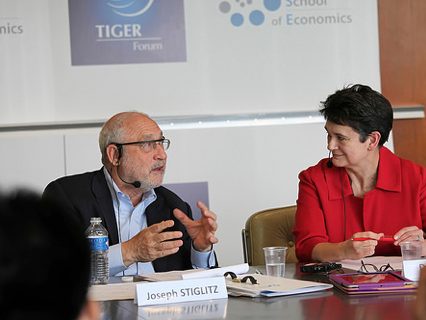
Prof Stiglitz and me at the TSE TIGER Forum


The Above from

The Enlightened Economist

Economics and business books



Cautious giant leaps


Blogger Ref http://www.p2pfoundation.net/Transfinancial_Economics


The argument of Why Government Fails So Often and How It Can Do Better by Peter Schuck is set out wonderfully succinctly in the title, and the book does an excellent job of telling half of the story about the role of governments and markets in delivering economic outcomes.


The chapters cover a range of reasons for ‘government failure’. To list them, they are: incentives not aligned with the policy’s aims; non-rational choice; lack of information; lack of flexibility in delivering outcomes when circumstances change or things don’t work out; lack of government credibility so essential co-operation is not forthcoming; mismanagement including fraud and abuse. Schuck argues that these barriers to policy success have a “deep, structural, endemic nature.”
The book has many examples of policy failure – it’s an American and to be honest far less amusing version of The Blunders of Our Governments by Anthony King and Ivor Crewe. It’s hard to argue with the examples. This book cites also Clifford Winston’s Government Failure versus Market Failure, which has many more. indeed, there have been loads of policy failures, in all kinds of places and contexts.
An aspect of the argument here that I strongly agree with is the failure of policy analysts to build themselves into their ‘impact analysis’ or whatever framework they use for assessing the likely success of the initiative. In other words, the incentives the policy will create for the people affected to change their behaviour are hardly ever incorporated. Economists often think of themselves as being ‘outside’ the society, in a benign deus ex machina role.Yet all policies alter people’s behaviour and have many side-effects.
Schuck’s book does end with a chapter on policy successes – in fact it finds nine, including Airline Deregulation in 1978, the 1975 Earned Income Tax Credit, the food stamp program, the interstate highway system and the 1965 Voting Rights Act. However, it concludes: “It is hard to know for sure why these (and other) policies have succeeded when so many others have failed. Low costs, simple implementation, strong public good characteristics, and replacing far worse policies are all given as potential explanations. However, Schuck also concludes: “To succeed, the programs needed to engage the actors’ self-interest; they did not need to create new values or transform behaviors.” But he believes that the ‘low hanging fruit’ has gone.
Hence his main recommendation – be cautious. “Realistic meliorism” – make things a little bit better but keep your ambitions modest. The policy ‘doing better’ bit of the book’s title is doing far less.
I’m all for realism. There’s a missing half of the story here, though, which is how government actions unavoidably shape markets, so that to argue ‘don’t do much and just leave it to the market’ is in itself a policy. Collective choices are inevitable and government is how we make those choices. Why Government Fails So Often should be read alongside Colander and Kuper’s  recent book Complexity and the Art of Public Policy, which is about policy as determining the structure of a complex, and uncontrollable (in the old-fashioned policy sense) economy and society.
That approach is hard to get right too, but as it’s impossible not to have a structure within which markets operate, because here we are at a point in history where we have actually existing markets, it surely makes sense for governments to think about that structure. And while caution, in the face of the record of policies ranging from the inept to the horribly counter-productive, is surely sensible, thinking about structure does not automatically point to incrementalism.  Sometimes a cautious giant leap might be just the thing.


The Above from

The Enlightened Economist

Economics and business books


Economists and humanity


Peter Smith sent me his new book The Reform of Economics: How the complex systems approach is building a realistic and humane alternative to laissez-faire. In a letter accompanying it, he said he has two motivations. One is to get economics out of the trap of over-simplifying so that models can use linear algebra and thus be made ‘tractable’. This is one of the things that makes complexity economics and agent-based modelling appealing; virtual economies run on a computer do not need to be solved algebraically.


The other aim is to make economic methodology something more like normal scientific methodology. Economic method consists of choosing some basic postulates and making deductions from them. The deductions can then be tested against data. Normal science involves both induction and deduction. Careful empirical observation will shape theory.
The book dates the choice of the purely deductive path to Lionel Robbins and his 1935 essay The Nature and Significance of Economic Science. He defined economics as the science of constrained choice, which, “Not only excludes uncertainty, but it also excludes from the scope of economics both institutions and the medium-term evolution of economic systems.” This isolates economics from the institutional framework of the economy, and hence from what determines the availability of resources over time – it makes economics an inherently static subject.
Natural scientists do regard economics as bizarrely non-empirical – I’ve been in multi-disciplinary conferences about both macroeconomics and behavioural choice at which biologists exclaim about how rarely economists discuss data, for all that they might go away and test hypotheses. One of the joys of being on the Competition Commission for eight years was how profoundly evidence-based the process is, and hence a real insight for an economist used to generalising about how companies behave. There aren’t many business people who think about marginal cost curves and production functions.
The Reform of Economics is a game of two parts (not halves). It is mostly a critique of economic methodology but also has a useful introduction to agent based modelling. It ends on an upbeat note I very much like:
“Economics is becoming a much more interesting area in which to work and learn; and we have every hope that a more realistic and effective reformed science of economics will also be a more humane one. For, ultimately, economics is about the well-being of humanity.”


The Above is from


The Enlightened Economist

Economics and business books


Friedman's k-percent rule


 Wikipedia, the free encyclopedia
Jump to: navigation, search
Friedman's k-percent rule is the monetarist proposal that the money supply should be increased by the central bank by a constant percentage rate every year, irrespective of business cycles. Milton Friedman coauthored a book with Anna Schwartz to summarise a historical analysis of monetary policy, called "Monetary History of the United States 1867-1960". The book attributed inflation to excess money supply generated by a central bank. It attributed deflationary spirals to the reverse effect of a failure of a central bank to support the money supply during a liquidity crunch. Friedman proposed a fixed monetary rule, called Friedman's k-percent rule, where the money supply would be calculated by known macroeconomic and financial factors, targeting a specific level or range of inflation.
Under this rule, there would be no leeway for the central reserve bank as money supply increases could be determined "by a computer" and business could anticipate all monetary policy decisions.[1][2]


Definition[edit]

According to Friedman, "The stock of money [should be] increased at a fixed rate year-in and year-out without any variation in the rate of increase to meet cyclical needs" (Friedman, 1960). Friedman was of the view that the main policy to be avoided is countercyclical monetary policy, the standard Keynesian policy recommendation at the time. He believed giving governments any flexibility in setting money growth would lead to inflation and therefore, the central bank should follow a procyclical monetary policy and expand the money supply at a constant rate, equivalent to the rate of growth of real GDP.

Monetary policy[edit]

Monetary policy is the process by which the monetary authority of a country controls the supply of money, often targeting a rate of interest for the purpose of promoting economic growth and stability. The official goals usually include relatively stable prices and low unemployment.
Framing the monetary policy is a very complicated and difficult task as balance has to be maintained between different economic variables. A tradeoff usually has to be made between these economic variables. Policymakers often make use of monetary rules like Friedman's k-percent rule or the Taylor rule to design more effective monetary policies.

Rules vs. discretion in monetary policies[edit]

Many economists have argued whether using Rules in framing monetary policies is better than the discretion of the policy maker and vice versa. The rules vs. discretion debate was the mainstream argument of monetary policy framing in the 1960s to the 1980s and there is still no single opinion on what is better. However, some economists like John B. Taylor are inclined towards using rules rather than discretion. Taylor said, "You do not prevent bailouts by giving the government more power to intervene in a discretionary manner. You prevent bailouts by requiring adequate capital based on simple, enforceable rules and by making it possible for failing firms to go through bankruptcy without causing disruption to the financial system and the economy,"[citation needed] indicating a clear preference over rules rather than discretion in monetary policies.
Economists and policy makers strive to formulate monetary policies using Rules but allowing scope for discretion so as to adjust the policies appropriate to the current economic situation so as to make these policies more effective.
The Friedman's k-percent rule, however, does not allow any interference from central banks in framing the monetary policy, as Friedman believed that discretion would be counterproductive and could lead to increased levels of inflation instead of controlling it. The K-percent rule does not allow any discretion in framing of monetary policies and believes in strict adherence to the proposed rule. This has caused many economists to criticise Freidmans k-percent rule.

Modified k-percent rule[edit]

Economists and policy makers have modified Friedman's k-percent rule and have developed more sophisticated rules for framing monetary policy, using the k-percent rule as a base. Joachim Scheide, head of the Forecasting Center at the Kiel Institute for the World Economy in Germany, has modified the k-percent rule to make it more applicable in context of Germany's economy. He uses three new variables "nominal domestic demand," "central bank money," and "error term with the standard characteristics" to give a more suitable model.
The k-percent rule is considered a no feedback rule, which does not allow central banks to alter monetary policy to adjust to current economic situations; thus, it is not effective in the short term.

Criticisms[edit]

No feedback is considered in this policy, as it believes in no interference of the central bank. It does not help in the short term and does not allow central banks to respond directly to immediate financial and economic turmoil.
This is not to be confused with the Friedman rule, which is a policy of zero nominal interest rates.

See also[edit]

References[edit]

  1. Jump up ^ Thomas Palley, "Milton Friedman: The Great Conservative Partison"
  2. Jump up ^ Ip, Greg; Whitehouse, Mark (2006-11-17). "How Milton Friedman Changed Economics, Policy and Markets". The Wall Street Journal. 

Further reading[edit]

Milton Friedman (1960), A Program for Monetary Stability (New York: Fordham University Press).

Tuesday, 1 July 2014

Money, Blood, and Revolution, by George Cooper


Author: Isabelle Crosby


HOW DARWIN & THE WORKINGS OF THE HUMAN HEART COULD FIX THE BROKEN SCIENCE OF ECONOMICS ONCE AND FOR ALL.

Many authors have written about the failure of economic theory but best-selling financial author, George Cooper, seems to be the first to have come up with an original solution on how to fix both economic theory and the economies of the world once and for all. He has done this by “plagiarising from the masters’ (in his own words) and taking the key ideas from the greatest scientific revolutions in history to re-imagine how our economies really work in the first place.  Once you figure that out, it is much easier to identify the flaws. Child’s play? Why, yes. In fact, it could be taught in junior school.

By illustrating how both our economic theories and our economic policies can be fixed, Cooper is setting out to present a simple idea that has the power to revolutionise how we think about our economies and how our governments set their policies – he calls the idea the circulatory growth model in his new book Money, Blood and Revolution, published by Harriman House.

The circulatory growth model could help policy makers understand what really drives economic growth. It recognises that capitalism has a tendency towards wealth and income polarisation and explains how this problem can be addressed. The model makes it very clear why the financial crisis happened in the first place and why the policies we’ve been running since then – quantitative easing for example – have not really brought our economies back onto a sustainable growth path. If the model gets an audience and becomes widely understood it should help drag the policy debate back toward the centre ground. In the last few decades, economic theory has become surprisingly extremist, in ways that not many people understand. This is doing a lot of damage to our economies. For example the model makes it immediately obvious how policies designed to promote borrowing lead directly to lower economic growth, higher income inequality and, in the end, to higher government deficits. If the model can help fix that unholy trinity then it will have done some good.

The way Cooper gets to his circulatory growth model is as fascinating as the model itself. There are no pages of dry economic arguments, no equations and even the ubiquitous economic charts are banished to just the final chapter. Instead Cooper takes his readers on a remarkable journey through the history and philosophy of scientific progress.
He starts with the scientific philosopher Thomas Kuhn’s analysis of the process of scientific revolutions. He then goes on to illustrate Kuhn’s ideas with the stories of four of the greatest scientific revolutions in history: the Copernican revolution in astronomy, which started the modern scientific age; William Harvey’s theory of blood flow, which led to the development of modern medicine; Darwin’s discovery of evolution, which turned biology into a science; and Alfred Wegener’s theory of continental drift which allowed geology to also graduate to the science faculty.
Both Kuhn’s work and the stories of Copernicus, Harvey, Darwin and Wegener are there to soften his readers up for what comes in the second section of the book.

He compares the confused state of economics today to the confusion which dogged astronomy, medicine, biology and geology prior to their respective revolutions. In doing this he builds a persuasive case that economics is long overdue its very own scientific revolution.

Cooper constructs his circulatory growth model drawing directly on the ideas of Darwin and William Harvey, the doctor of King Charles I. The connections which he sees between previous scientific revolutions and his proposed scientific revolution for the field of economics are fascinating.

The circulatory growth model has some surprising implications. It shows, for example, why some countries have prospered while others have failed. It also shows why government spending and taxation are necessary for economic growth. These conclusions fly in the face of today’s accepted mainstream economic ideas, which press always for smaller governments and lower taxation.

Few readers will emerge from Money, Blood and Revolution with their preconceptions unscathed and a few policy makers may suffer more than superficial damage to their own ideas. Personally, I was very entertained by Cooper’s ability to link Captain Kirk to Copernicus, Darwin to the Declaration of Independence and the workings of the human heart to the ideas of Karl Marx and Adam Smith.  A jolly good read and renewed hope for a better world in one. How marvellous!

See also:
Review on Money, Blood and Revolution by The Economist

Ref Rethinking Economics Blog