Exploring mainly Heterodox type Economics, Monetary Reform, Environmental Sustainability, and Climate Change. It is a resource of Internet articles, and also promotes awareness of a futuristic modern universal Paradigm known as TFE, or Transfinancial Economics which is probably the most advanced, and most "scientific" form of Economics in the world .
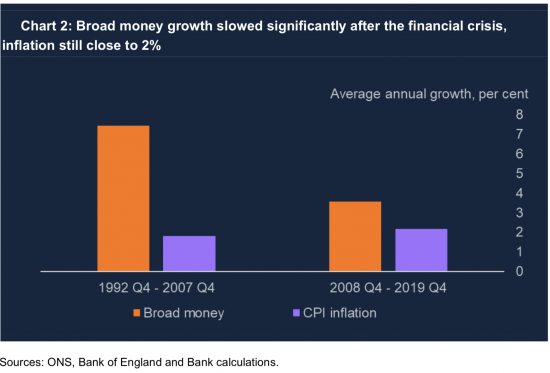
Certainly the very strongest claims – that QE inevitably leads to rapid growth of commercial bank deposits (M4), on a par with that in the central bank's balance sheet; and that this, in turn, inevitably leads to excessive inflation – are not well supported by the evidence. Broad money grew more than twice as rapidly in the first fifteen years of inflation targeting (when there was no QE) than in the decade or so after the financial crisis (when there was lots). And average inflation, in both periods, was close to 2%.
In effect, the argument he made was that the creation of new money by the Bank of England under cover of the quantitative easing process, did not result in inflation.
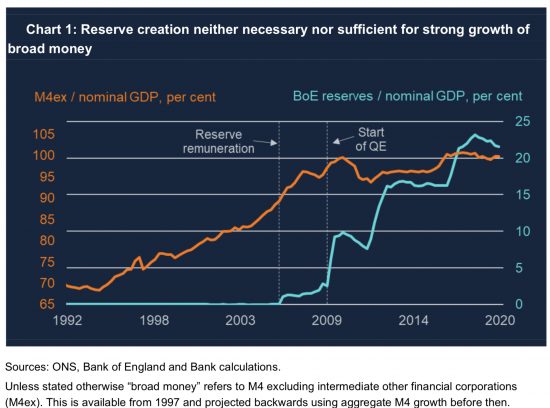
He developed this thesis using several charts:
The argument made, based on this chart, is that the growth in central bank, base, narrow or reserve account money (they are, effectively, all the same thing, with all of it being constrained within the Bank of England inter-bank settlement cycle through the central bank reserve accounts) is not related to the growth in commercial bank or broad money, which is what is actually used in the economy in which we all operate. It's a notable and appropriate suggestion.
Broadbent reinforced the claim by suggesting that the global financial crisis changed the pattern of money creation, but doing so did not result in inflation:
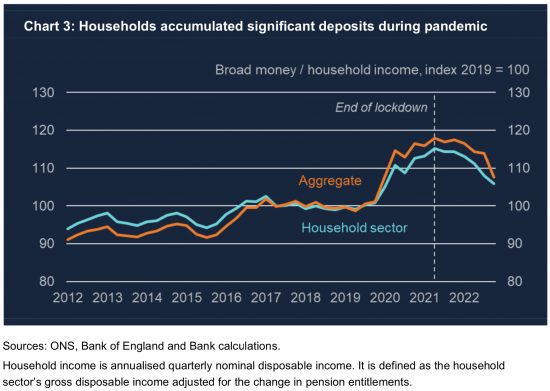
The point he then noted was that the impact of Covid was that some in society did save using broad or commercial bank-created money:
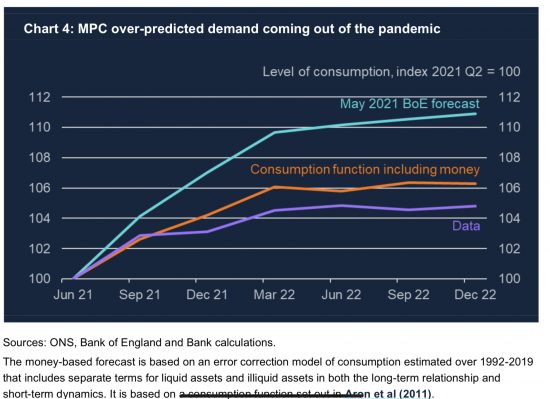
What the Bank then expected was that people would then spend that pent-up money. This is what those who claim the QE created inflation also suggest. However, as Broadbent notes, that tendency to spend was much smaller than expected:
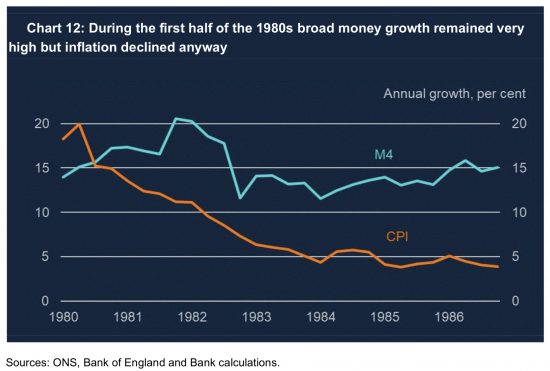
Broadbent then used a New Keynesian, and so deeply neoclassical, explanation for what did happen in the macroeconomy. From this he concluded that, firstly, it was external shocks that created this inflation and, secondly, like Huw Pill, he thinks we must accept that we are worse off as a result. I do not agree with the reasons he gave, but what I do agree with is his conclusion that central bank money creation, let alone broad money creation, is not closely (if very much at all) linked to inflation. His Chart 12 provided support:
Money supply growth was high. Inflation was not. At the very least, the velocity of circulation of money dropped dramatically. The obvious explanation for that is growing inequality. He did not say so.
Where I do agree with Ben Broadbent is that there is no obvious evidence that QE did in any way result in inflation. I think it is time to dismiss that argument.
Does money matter? Does wealth make us rich any more? These might seem like odd questions for a physicist to try to answer, but Britain’s referendum decision is a reminder that everything is connected and that if we wish to understand the fundamental nature of the universe, we’d be very foolish to ignore the role that wealth does and doesn’t play in our society. I argued during the referendum campaign that it would be a mistake for Britain to leave the European Union. I’m sad about the result, but if I’ve learned one lesson in my life it is to make the best of the hand you are dealt. Now we must learn to live outside the EU, but in order to manage that successfully we need to understand why British people made the choice that they did. I believe that wealth, the way we understand it and the way we share it, played a crucial role in their decision. As the prime minister, Theresa May, said in her first week in office: “We need to reform the economy to allow more people to share in the country’s prosperity.”
We all know that money is important. One of the reasons I believed it would be wrong to leave the EU was related to grants. British science needs all the money it can get, and one important source of such funding has for many years been the European commission. Without these grants, much important work would not and could not have happened. There is already some evidence of British scientists being frozen out of European projects, and we need the government to tackle this issue as soon possible.
Money is also important because it is liberating for individuals. I have spoken in the past about my concern that government spending cuts in the UK will diminish support for disabled students, support that helped me during my career. In my case, of course, money has helped not only make my career possible but has also literally kept me alive.
On one occasion while in Switzerland early on in my career, I developed pneumonia, and my college at Cambridge, Gonville and Caius, arranged to have me flown back to the UK for treatment. Without their money I might not have survived to do all the thinking that I’ve managed since then. Cash can set individuals free, just as poverty can certainly trap them and limit their potential, to their own detriment and that of the human race.
Interestingly this attitude, for a long time seen as the predictable eccentricity of a Cambridge academic, is now more widely shared. People are starting to question the value of pure wealth. Is knowledge or experience more important than money? Can possessions stand in the way of fulfilment? Can we truly own anything, or are we just transient custodians?
These questions are leading to a shift in behaviour which, in turn, is inspiring some groundbreaking new enterprises and ideas. These are termed “cathedral projects”, the modern equivalent of the grand church buildings, constructed as part of humanity’s attempt to bridge heaven and Earth. These ideas are started by one generation with the hope a future generation will take up these challenges.
I hope and believe that people will embrace more of this cathedral thinking for the future, as they have done in the past, because we are in perilous times. Our planet and the human race face multiple challenges. These challenges are global and serious – climate change, food production, overpopulation, the decimation of other species, epidemic disease, acidification of the oceans. Such pressing issues will require us to collaborate, all of us, with a shared vision and cooperative endeavour to ensure that humanity can survive. We will need to adapt, rethink, refocus and change some of our fundamental assumptions about what we mean by wealth, by possessions, by mine and yours. Just like children, we will have to learn to share.
If we fail then the forces that contributed to Brexit, the envy and isolationism not just in the UK but around the world that spring from not sharing, of cultures driven by a narrow definition of wealth and a failure to divide it more fairly, both within nations and across national borders, will strengthen. If that were to happen, I would not be optimistic about the long-term outlook for our species.
But we can and will succeed. Humans are endlessly resourceful, optimistic and adaptable. We must broaden our definition of wealth to include knowledge, natural resources, and human capacity, and at the same time learn to share each of those more fairly. If we do this, then there is no limit to what humans can achieve together. • Stephen Hawking recently launched www.unlimited.world
- When I say 'decentralize everything', I am referring to the 4 elements mentioned at the end of the video: information, authority, wealth & energy.
- The decentralization of these industries is going to happen whether you like it or not... technology is liberating the individual, but will cause traditional establishments to do whatever they can to maintain centralised control.
- The decentralization of industries such as energy etc. is not an overnight thing - it is generational. We are going to see huge changes occur over the next 40 years, and we must do all we can to keep progressing forward if we have any hope of surviving as a human race by the end of the century.
- The emergence of technologies is going to completely transform how the world functions because 'jobs' will cease to exist like they do now. People currently try to work on projects they are passionate about (volunteering being a great example), but the moment people stop chasing these desires, is when they have to put their hand up and say "sorry, i've now got to pay the bills in whatever way possible." -
Consider what you need 'money' for in today's society? Now imagine a world where everyone is generating their own energy as explained in the video... Energy that could power 3D printers, transport, and other facilities in local and global communities via a grid system. Couldn't 'energy' become the new currency freeing humans to work on the projects in society they wish to do most?
Do you only sorta-kinda know about economics? Are you unsure about the difference between budget deficit and the national debt? You should read this entertaining lexicon
Professional hustlers … Dan Akroyd and Eddie Murphy in Trading Places.
On the night before Christmas Eve, our family has a ritual. We go to the panto and then for a curry. Finally, we sit down to watch Trading Places, arguably the greatest Christmas film ever and unarguably the best film ever about the way financial markets work. Anybody who wants to understand what is meant by taking a long position or a margin call could do a lot worse than spend a couple of hours watching what happens when a couple of unscrupulous commodities traders decide, for a bet, to replace their Harvard-educated chief executive (Dan Aykroyd) with a hustler from the ghetto (Eddie Murphy).
How to Speak Money
by John Lanchester
John Lanchester is a Trading Places fan. That's evident from his latest attempt to demystify the workings of the global economy and the financial markets. How to Speak Money is really a Bluffer's Guide, albeit a top-of-the-range job. Read this and you will know your Laffer curve from your Glass-Steagall Act. You will also discover that there is an Eddie Murphy rule, based on the proposed law changes in the US to prevent people using wrongly acquired information to rig the commodities market. It references the scam Murphy and Aykroyd pull in the denouement to Trading Places.
Lanchester's lexicon is not aimed at professional economists and investment bankers. To be sure, they could happily while away a couple of hours looking for omissions and errors, but this is really a book for interested amateurs. These fall into two camps: the people who haven't really got a clue why the global economy teetered on the brink of disaster in the winter of 2008 and want to know why; and people who think they understand why the Royal Bank of Scotland came within a couple of hours of switching off its cash machines but whose knowledge is, in truth, a bit fuzzy.
As Lanchester puts it, he is writing a book for people who "sorta-kinda" know what's happening. They watch the news and think they know what is meant by fiscal policy and sub-prime mortgages but couldn't say for sure. "I know all about this type of semi-knowledge because I was completely that person," he says in the introduction: "the one who sorta-kinda knew what was being talked about, but not in enough detail to really engage with the argument in a fully informed, adult manner".
That may have been the case once. This, though, is Lanchester's third go at lifting the bonnet of the modern globalised, financialised economy. The first was Whoops!, one of the best books about what led to the end of the long boom that followed the collapse of communism. The second was Capital, a fictional account of life in London at the moment the sky fell in. How to Speak Money is a more difficult book to pull off, because in essence it's a long and specialised list. But it works – for three reasons. First, Lanchester is a fine writer. His prose is clear and precise, and that helps a lot when the subject matter is challenging. Second, he peps up the list with humour. As someone who has always thought the definition of "flexible labour market" is "you're fired", I was tickled by the following three entries:
Reducing payroll Sacking people. Redundancy Sacking people. Reform This is something of a weasel word. In its modern economic usage it never, ever, not once, means 'hiring more people and giving your current workforce more generous pay and conditions'. Instead it usually means sacking people and making the ones who are in work do more for less.
Third, he gets the balance right: the book is neither too technical nor too patronising. He provides a long introduction of more than 60 pages explaining why the language of money matters, and a shorter afterword in which he explores how we can put all this newfound knowledge to good use.
These two bookends demonstrate where Lanchester is coming from. He thinks, rightly, that something went badly wrong with economics in the final quarter of the 20th century, an era in which, under the guise of acting out of pure rationality, the financial markets turned into a giant doomsday machine. When the crisis broke in the summer of 2007, few people really understood what the traders had been doing with their fancy models and their exotic financial instruments. In some cases, that included those running the big banks, who didn't ask questions so long as the profits were rolling in.
Since 2007, more questions have been asked, but curbs on finance have been far more modest than those placed on the unions after they were deemed to have screwed up the economy in the 1970s. Little has fundamentally changed, apart from the fact that all of us, the bankers apart, are poorer.
This matters. The important question thrown up by the crisis, Lanchester says, is "whether a society should arrange itself primarily for the convenience of its richest citizens and its richest, most powerful economic sector, irrespective of the consequences of that for everyone else". He notes that a robber baron's castle can be full of sumptuous art, lavish food and drink and wonderful music but can only shine brightly because it destroys the landscape in which it sits. "The City of London," he writes, "is a robber baron's castle."
Lanchester thinks the robber barons get away with it because of the big gap that exists between the people who understand money and the rest. And the reason there is a big gap, he says, is that the money folk speak their own esoteric language that sets them apart. That explains why economics feels so alienating to outsiders.
In truth, there is more to the power of finance than its use of obfuscatory language. The global banks are now so big and interlocked that breaking them would be hard to do even if politicians had the will. Which they don't, because the banks are the most powerful lobbying force on earth, and have burrowed their way deep into the political structure of every western nation. But change has to start somewhere.
Lanchester's book has its omissions. There is no entry for David Ricardo, the 19th-century economist responsible for the theory of why countries trade with each other. Nor is there a mention of Hyman Minsky, whose explanation of why financial crises occur has become fashionable since the great recession of 2008-09.
It is also annoying that the book does not have an index. Presumably, the publishers thought the list format made it unnecessary, but they were wrong. Searching for the reference to Isaac Newton – who despite being the cleverest man in the world lost a packet in the South Sea Bubble – I had to skim through every listing before finding it (under "greater fool theory").
But these are minor quibbles. For all the "sorta-kinda" people, this book is invaluable. And if you're still not sure if you are a sorta-kinda person, here's a simple experiment for you. Can you explain the difference between the budget deficit and the national debt? What is the output gap? What happens to bond yields when the price goes up? If you can answer all three questions, congratulations: you already know how to speak money.
At the outbreak of World War II, the Philippines faced serious monetary problems, specifically, the devaluation of peso. During the Japanese occupation, the government issued fiat money known as the Japanese government-issued Philippine fiat peso or Japanese peso. The currencies were released in surplus. These were practically worthless that the people called these Mickey Mouse Money (similar to play money). Since the money were almost invaluable, the people can be seen carrying suitcases or bayong overflowing with the Japanese peso -it entailed one to pay bags of money for a piece of bread. <ref name="test1">"Money Matters." (accessed on 18 January 2008)</ref>
Two kinds of notes were issued in the country during the first period of Japanese occupation – first, the war notes released by the Japanese forces; and second, the guerilla notes or resistance currencies issued by different provinces and municipalities. Then PresidentJose P. Laurel outlawed the possession of guerilla notes, and those found having one were sanctioned by the Philippine government in-exile, and were later freed after WWII.
HOW DARWIN & THE WORKINGS OF THE HUMAN HEART COULD FIX THE BROKEN SCIENCE OF ECONOMICS ONCE AND FOR ALL.
Many authors have written about the failure of economic theory but best-selling financial author, George Cooper, seems to be the first to have come up with an original solution on how to fix both economic theory and the economies of the world once and for all. He has done this by “plagiarising from the masters’ (in his own words) and taking the key ideas from the greatest scientific revolutions in history to re-imagine how our economies really work in the first place. Once you figure that out, it is much easier to identify the flaws. Child’s play? Why, yes. In fact, it could be taught in junior school.
By illustrating how both our economic theories and our economic policies can be fixed, Cooper is setting out to present a simple idea that has the power to revolutionise how we think about our economies and how our governments set their policies – he calls the idea the circulatory growth model in his new bookMoney, Blood and Revolution, published by Harriman House.
The circulatory growth model could help policy makers understand what really drives economic growth. It recognises that capitalism has a tendency towards wealth and income polarisation and explains how this problem can be addressed. The model makes it very clear why the financial crisis happened in the first place and why the policies we’ve been running since then – quantitative easing for example – have not really brought our economies back onto a sustainable growth path. If the model gets an audience and becomes widely understood it should help drag the policy debate back toward the centre ground. In the last few decades, economic theory has become surprisingly extremist, in ways that not many people understand. This is doing a lot of damage to our economies. For example the model makes it immediately obvious how policies designed to promote borrowing lead directly to lower economic growth, higher income inequality and, in the end, to higher government deficits. If the model can help fix that unholy trinity then it will have done some good.
The way Cooper gets to his circulatory growth model is as fascinating as the model itself. There are no pages of dry economic arguments, no equations and even the ubiquitous economic charts are banished to just the final chapter. Instead Cooper takes his readers on a remarkable journey through the history and philosophy of scientific progress.
He starts with the scientific philosopher Thomas Kuhn’s analysis of the process of scientific revolutions. He then goes on to illustrate Kuhn’s ideas with the stories of four of the greatest scientific revolutions in history: the Copernican revolution in astronomy, which started the modern scientific age; William Harvey’s theory of blood flow, which led to the development of modern medicine; Darwin’s discovery of evolution, which turned biology into a science; and Alfred Wegener’s theory of continental drift which allowed geology to also graduate to the science faculty.
Both Kuhn’s work and the stories of Copernicus, Harvey, Darwin and Wegener are there to soften his readers up for what comes in the second section of the book.
He compares the confused state of economics today to the confusion which dogged astronomy, medicine, biology and geology prior to their respective revolutions. In doing this he builds a persuasive case that economics is long overdue its very own scientific revolution.
Cooper constructs his circulatory growth model drawing directly on the ideas of Darwin and William Harvey, the doctor of King Charles I. The connections which he sees between previous scientific revolutions and his proposed scientific revolution for the field of economics are fascinating.
The circulatory growth model has some surprising implications. It shows, for example, why some countries have prospered while others have failed. It also shows why government spending and taxation are necessary for economic growth.These conclusions fly in the face of today’s accepted mainstream economic ideas, which press always for smaller governments and lower taxation.
Few readers will emerge from Money, Blood and Revolution with their preconceptions unscathed and a few policy makers may suffer more than superficial damage to their own ideas. Personally,I was very entertained by Cooper’s ability to link Captain Kirk to Copernicus, Darwin to the Declaration of Independence and the workings of the human heart to the ideas of Karl Marx and Adam Smith.A jolly good read and renewed hope for a better world in one. How marvellous!
See also: Review on Money, Blood and Revolution by The Economist
It’s time to shine a light on the deals and the money
Secrecy in the oil, gas and mining sector allows the corrupt to steal billions.
Nigeria has been in the midst of an oil boom for over 50 years, yet 84% of Nigerians live on less than $2 a day. An estimated $400bn has gone missing from oil revenues in the country. This was possible because the secrecy in which the oil, gas and mining deals are conducted allows corruption to flourish.
If citizens, journalists and MPs don’t know the details of natural resource deals and payments, they can’t hold their governments to account.
Global Witness has been campaigning for transparency for 20 years. Our campaigning has led to the establishment of the Extractive Industries Transparency Initiative which requires companies in countries like Nigeria to declare what they pay to governments and governments to declare what they receive to allow citizens to follow the money.
We've also campaigned for ground-breaking new transparency laws in the US and the EU which mean that most of the world's biggest oil and mining firms are now required to declare what they pay to governments.
In the face of a big backlash from big oil and gas companies who want to continue to operate in secret, we’re continuing our campaigns for transparency.
Read more about our campaigns below.
President Lula giving a speech to recipients of Bolsa Família and other federal assistance programs in Diadema
The family of Selma Ferreira was the first recipient of Bolsa Escola, a precursor to Bolsa Família enacted by governor Cristovam Buarque of the Federal District in 1995.
Bolsa Família (Portuguese pronunciation: [ˈbowsɐ faˈmiliɐ], Family Allowance) is a social welfare program of the Brazilian government, part of the Fome Zero network of federal assistance programs. Bolsa Família provides financial aid to poor Brazilian families; if they have children, families must ensure that the children attend school and are vaccinated. The program attempts to both reduce short-term poverty by direct cash transfers and fight long-term poverty by increasing human capital among the poor through conditional cash transfers. It also works to give free education to children who cannot afford to go to school to show the importance of education.[1] The Economist described Bolsa Família as an "anti-poverty scheme invented in Latin America" (which) "is winning converts worldwide."[2]
The program was a centerpiece of President Luiz Inácio Lula da Silva's social policy, and is reputed to have played a role in his victory in the Brazilian presidential election, 2006.[3] Bolsa Familia is currently the largest conditional cash transfer program in the world, though the Mexican program Oportunidades was the first nation-wide program of this kind.[4]
The Bolsa Familia program has been mentioned as one factor contributing to the reduction of poverty in Brazil, which fell 27.7% during the first term in the Lula administration.[5] Recently the Center of Political Studies of the Getulio Vargas Foundation has published a study showing that there was a sharp reduction in the number of people in poverty in Brazil between 2003 and 2005.[6] Other factors include an improvement in the job market and real gains on the minimum wage.[5]
About 12 million Brazilian families receive funds from Bolsa Família,[7] which has been described as "the largest programme of its kind in the world."[7]
By February 2011, 26% of the Brazilian population were covered by the program.[8]
Bolsa Escola, a predecessor which was conditional only on school attendance, was pioneered in Brasilia by then-governor Cristovam Buarque. Not long after, other municipalities and states adopted similar programs. President Fernando Henrique Cardoso later federalized the program. In 2003, Lula formed Bolsa Família by combining Bolsa Escola with Bolsa Alimentação and Cartão Alimentação (all part of Lula's Fome Zero anti-hunger program) and Auxílio Gas (a transfer to compensate for the end of federal gas subsidies). This also meant the creation of a new Ministry – the Ministério do Desenvolvimento Social e Combate à Fome (Ministry for Social Development and War Against Hunger). This merger reduced administrative costs and also eased bureaucratic complexity for both the families involved and the administration of the program.
Programs employing various types of conditional cash transfer are social policies currently employed in many places in the world to fight and reduce poverty. In the short term, the aim is to mitigate the problems resulting from poverty. In the long term, the goal is to invest in human capital and interrupt the transgenerational cycle of poverty (i.e. from one generation to another). Conditional cash transfer programs began to gain strength in 1997. At the time there were only three countries in the world with this experience: Bangladesh, Mexico and Brazil.
Bolsa Família currently gives families with per-capita monthly income below $140 BRL (poverty line, ~$56 USD) a monthly stipend of $32 BRL (~$13 USD) per vaccinated child (< 16 years old) attending school (up to 5), and $38 BRL (~$15 USD) per youth (16 or 17 years old) attending school (up to 2). Furthermore, to families whose per-capita monthly income below $70 BRL (extreme poverty line, ~$28 USD), the program gives the Basic Benefit $70 BRL per month.[1][9]
This money is given preferentially to a female head of household,[10] through so-called Citizen Cards which are mailed to the family. This card operates like a debit card and is issued by the Caixa Econômica Federal, a government-owned savings bank (the second largest bank in the country). The money can be withdrawn in over 14,000 Caixa locations. This practice helps to reduce corruption,[citation needed]a long problem in Brazil, and helps to dissociate the receipt of money from individual politicians or political parties. The names of every person enlisted in the program and the amount given to them can be found online at the Portal da Transparência, the program's website.
Brazil has a strong federal system defined as the resource base of states, the power of governors, the articulation of subnational interests within the Brazilian National Congress, and the distribution of government across three levels of government. Hence, state governors are able to constrain the central government. This is allowed because of a weak, fragmented, institutionalized party system. Fragmentation makes it difficult for a non-consensual form to reach the central level, creating a policy challenge for national leaders. Fragmentation also makes it difficult for national leaders to reach a consensus when creating policies.
Cash transfer programs had previously existed in the Cardoso administration - Bolsa Escola, Bolsa Alimentação, Auxílio Gás. Most of these early programs faced internal organization challenges. Bolsa Escola was superior to other programs because it applied to all citizens and both supported and was associated with education.
During Lula’s first administration, his goal was to create a social program to replace the three previously existing programs of Cardoso’s government. He unified all prior programs to create one and provided a monetary amount per month that would allow households to rise above the poverty line.
As a redistributive program, it depends on central-local collaboration. Municipal governments act as the main agents of the federal government. Bolsa Família avoids negotiations between the executive and legislative branches. The central government’s ability to bypass twenty-seven powerful governors demonstrates that federalism in Brazil is a three-level game. In addition, state brokers cannot claim credit because it cuts out the intermediaries. Bolsa Família resolved intra-bureaucratic chaos by creating one program controlled by the national executive branch. It reduced administrative costs and facilitated user access.
Aside from the ability to bypass state involvement, there are additional enabling factors such as the interaction of a non-majoritarian system of government and fiscal incentives for central-local collaborations. Because of these factors, Bolsa Família helped reduce hunger and poverty. The dynamic relationship between the federal center and municipalities enabled a direct relationship between citizens and the government. The hardening budget constraints put in place by Cardoso’s administration to stabilize macroeconomic performance gave municipalities an incentive to collaborate with the central government. Their collaboration helps them meet their required percent that they are legally required to spend on social assistance. Municipalities that adhere to the program sign a covenant with the federal government, which guarantees the program’s promotion and availability of public services.
The federal center and municipalities’ abilities to collaborate with each other have facilitated Brazil’s capability to build an effective welfare policy for the poor. The existence of a power sharing logic in Brazil enabled a widespread means tested social program that was able to achieve success nationwide.
In 2006, Bolsa Familia is estimated to cost about 0.5% of Brazilian GDP and about 2.5% of total government expenditure. It will cover about 11.2 million families, or about 44 million Brazilians.[11]
The Bolsa Família was criticized by political opponents of President Lula for allegedly using the revenues of the CPMF tax (which was originally created under the pretext of financing the public health system during the Fernando Henrique Cardoso administration, but never actually did; the CPMF tax expired in December 2007, and was not renewed) for political and electoral purposes,[12] to the detriment of the public health system that currently faces enormous difficulties.[13]
The reaction from multilateral institutions to Bolsa Família has generally been enthusiastic. During a trip to Brazil in 2005, the former president of the World Bank, Paul Wolfowitz said, "Bolsa Familia has already become a highly praised model of effective social policy. Countries around the world are drawing lessons from Brazil’s experience and are trying to produce the same results for their own people." [14]
Certain sectors of the Brazilian society, both among the conservatives and the progressives, as well as the Catholic Church, oppose the concept of money transfers to the poor:
"This concept has always been controversial in Brazil. In other countries it is not this way, but in Brazil there has always been resistance. When I was in college they (the opponents to the concept of money transfers) used to say: 'the first thing the poor will do with the money is to get themselves drunk'. Later on, it was no longer getting drunk that people talked about; they would say the money transferred would be used by the poor to buy a battery radio. They assumed that people with less education would not use their money wisely." [15]
Q. Does that resistance make sense? A: No. In the 1980s (São Paulo State) Governor Franco Montoro had created a money transfer program to benefit families which were receiving their sons back home, coming out of "FEBEM" (the Brazilian punitive institution for minors). As it was very, very little money, families would get together to do house-raising, each month on somebody's house. Or families would save for months, to be able to buy a popcorn wagon for a youth who now had to start working. At the same time other programs, which provided food, failed because they did not take into account regional habits. Here in São Paulo, for instance, the Federal Government distributed tons of black beans, which are only eaten in Rio. People threw it away.[15]
The Bolsa Família Program is far from being universally accepted by the Brazilian society. Among the various criticisms it receives, one of the most recurrent is the assertion that it could discourage the search for employment, encouraging laziness of people. Under this premise, many people would give up trying to find a job, content, instead, to live on the Bolsa Família program.[citation needed].[16] The World Bank, however, finds that the program does not discourage work, nor social ascension. On the contrary, says Bénédicte de la Brière, responsible for the program monitoring at the institution:
"Adult work is not impacted by income transfers. In some cases adults will even work harder because having this safety net encourages them to assume greater risks in their activities"' [17]
Another heavy criticism of the government program is the fact that it is perceived by opponents of the currently ruling party as a program meant to "buy" votes of poor people, creating clientelism.
Many Brazilians, though, recognize that the Bolsa Família program has a potential for reducing absolute poverty and to reduce inter-generational transmission of poverty. For one example among many, Renata de Camargo Nacimento (heir to the powerful, Brazilian multi-billionaire Camargo Correa Group), when asked in an interview if she agreed that Bolsa Família is just a form of charity, answered as follows: "I travel a lot around Brazil and see many places where the average monthly income is BRL 50 (approximately US$ 26.32). In these places the Bolsa Familia comes in and adds an extra BRL 58. It makes all the difference in the world and adds a lot for the needy population. What is more important is that it promotes a virtuous circle. If there is more money in circulation, the local market heats up, the purchasing power is increased and the effects spread throughout the whole economy. But only to give money is not enough.(...)" [18]
Surveys conducted by the Federal Government among Bolsa Família's beneficiaries indicate that the money is spent, in order of priority, on food; school supplies; clothing; and shoes.[19] A study conducted by The Federal University of Pernambuco, using sophisticated statistical methods, inferred that 87% of the money is used, by families living in rural areas, to buy food.[20]
The program has clearly contributed to Brazil's recent improvements in its fight against poverty, according to research promoted by some universities and the Brazilian Institute of Geography and Statistics (IBGE). An ex anteeconometric evaluation of Bolsa Escola did find significant effects on both school attendance rates and the number of children involved in child labor.[21][22]
The World Bank, which provided a loan to assist the Brazilian government in managing the Bolsa Família Program,[23] declares that "Although the program is relatively young, some results are already apparent, including: (...) contributions to improved education outcomes, and impacts on children’s growth, food consumption, and diet quality".[24]
A study by the UNDP's International Policy Centre for Inclusive Growth[25] found that over 80% of the Bolsa Familia benefits go to families in poverty (making under half the minimum wage per capita), thus most of the benefits go to the poor. Bolsa Familia was also found to have been responsible for about 20% of the drop in inequality in Brazil since 2001, which is welcome in one of the most unequal countries on the planet.[26] Research promoted by the World Bank shows a significant reduction in child labor exploitation among children benefited by the Bolsa Família program.[27]
One positive effect of the program which is not immediately apparent is that it makes a significant impact on the ability of the poorest families to eat. Children in public schools receive one free meal a day—two in the poorest areas—and so less of their family's limited income is needed to pay for food. In a survey of Bolsa Familia recipients, 82.4% reported eating better; additionally, it was reported to increase the incomes of the poorer families by about 25%.[28]
Jump up ^HAAG, Carlos. O Discreto Charme Da Solidariedade, an Interview with Renata de Camargo Nascimento, São Paulo: Private Brokers, Year IV, Nr. 16, SEPT/OCT/NOV 2007, P. 41
Jump up ^YAP, Yoon-Tien, Guilherme Sedlacek and Peter Orazem. 2001. Limiting Child Labor Through Behavior-Based Income Transfers: An Experimental Evaluation of the PETI Program in Rural Brazil. World Bank, Washington, DC
YAP, Yoon-Tien, Guilherme Sedlacek and Peter Orazem. 2001. Limiting Child Labor Through Behavior-Based Income Transfers: An Experimental Evaluation of the PETI Program in Rural Brazil. World Bank, Washington, DC
WORLD BANK. 2001a. Brazil: An Assessment of the Bolsa Escola Programs. Human Development Department, Latin America and Caribbean Region, The World Bank, Washington, DC.